← All work [ Case study 01 · AstroAI ]

A kundli that shows its working.

An explainable Vedic astrology product for web and mobile — every reading links back to the calculation, the classical rule and the reasoning behind it.

Web + iOS + AndroidDesign system2026
AstroAI — key screens
Role
Product design, end to end — strategy, UX, UI, design system, prototype
Platforms
Responsive website · iOS & Android app
Tools
Figma — variables, components, auto layout, prototyping
Year
2026
[ 01 ] Overview

Turning a birth chart into an argument you can inspect.

Astrology products hand down conclusions. AstroAI separates what is calculated from what is interpreted.

01

The problem

People are told what their chart means without being shown why. Settings are hidden, apps contradict each other, and AI astrologers answer fluently without grounding.

02

The approach

Treat explainability as the product: a reasoning chain, provenance labels on every statement, and contradictions shown side by side.

03

The solution

A responsive website and a mobile app on one design system, with a “Why?” on every reading and a North Indian chart at the centre.

How might we

How might we help people understand what their birth chart says — and why — without asking them to believe it?

[ 02 ] What breaks trust

Eight trust problems, each with a product response.

From the product definition. Each is a hypothesis for the research plan, not a finding.

  1. 01

    Conclusions without reasons

    A “Why?” on every interpretation.

  2. 02

    Hidden settings

    Method and settings shown up front.

  3. 03

    Fear-driven design

    Calm language; no remedies commerce.

  4. 04

    Cherry-picking

    Supports and challenges side by side.

  5. 05

    Data without meaning

    Progressive disclosure, from simple to technical.

  6. 06

    AI that invents

    A grounded Ask that lists every factor it used.

  7. 07

    No sense of time

    A living dasha timeline.

  8. 08

    Birth-time uncertainty

    Confidence and sensitivity badges.

[ 03 ] Users

One chart, four kinds of reader.

Proto-personas that set the depth system — Simple, Detailed and Technical. To be validated in interviews.

Primary · Beginner

The Curious Skeptic

Help me understand what my chart actually says, and on what basis — without asking me to believe anything.
Primary · Intermediate

The Engaged Enthusiast

Show me why two apps disagree, and what my current dasha actually activates.
Secondary · Advanced

The Student / Practitioner

Give me an engine I can trust and a rule trace I can check against the texts.
Future · Delegate

The Family Asker

Explain my sister’s chart to me honestly.
[ 04 ] Principles & structure

Ten rules that decided every screen.

  1. 01Explain rather than predict.
  2. 02Never hide the reasoning.
  3. 03Separate calculation from interpretation.
  4. 04Don’t present astrology as fact.
  5. 05Don’t manufacture certainty.
  6. 06Show contradictions.
  7. 07AI never invents.
  8. 08Make method inspectable.
  9. 09Serve beginners and experts.
  10. 10One idea per screen — added after round 2.
User flow
Free KundliBirth detailsTime confidenceChart calculatedTodayTap a planetWhy?Rule & source
Information architecture
TodayKundliDashaAskYouWhy? sheetProvenance tagsBirth-time badge
[ 05 ] Key decisions

Patterns that make a reading checkable.

Decision 01

The “Why?” chain

The problem

Apps state outcomes; nobody can evaluate or disagree with them.

What I did

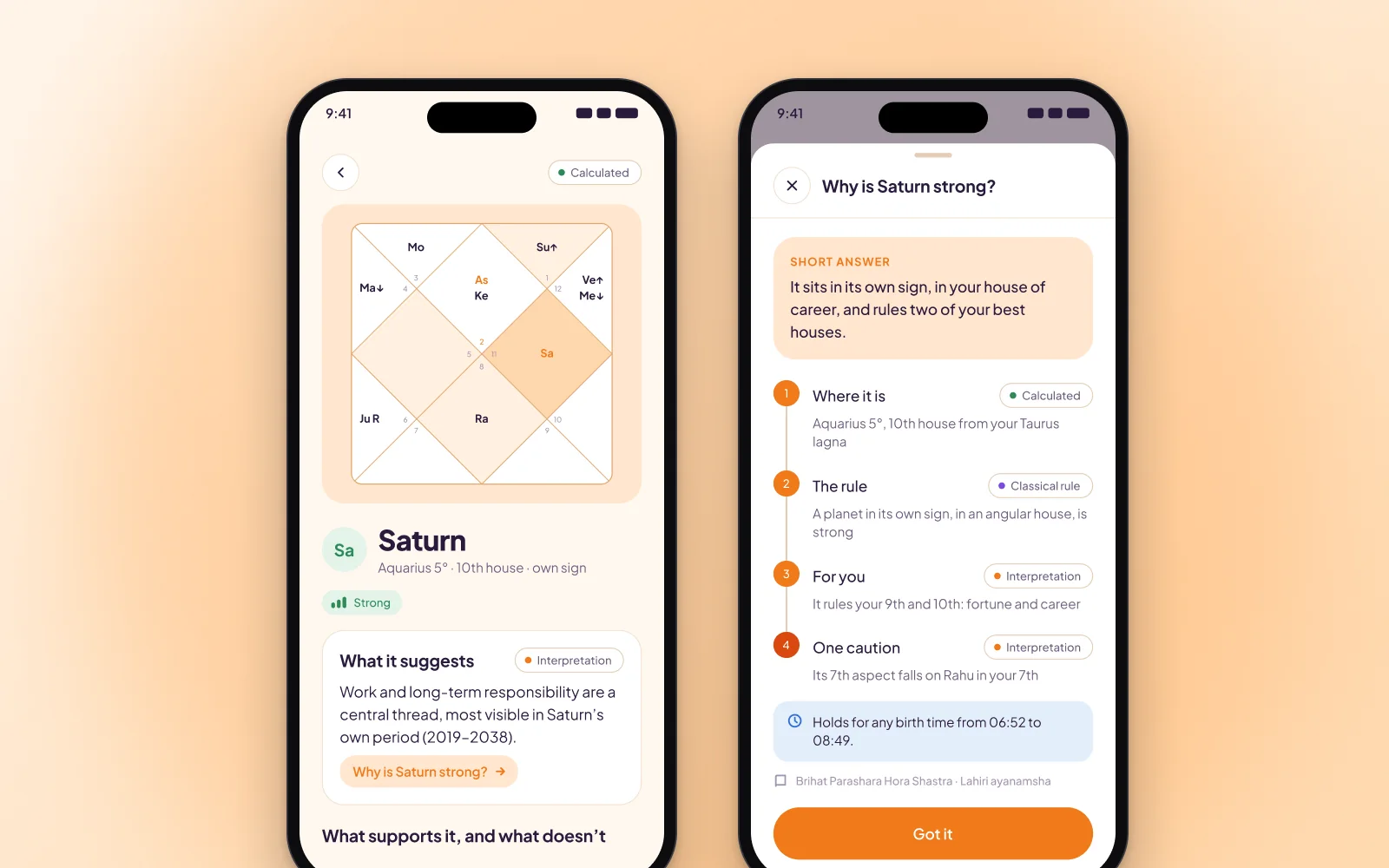
Every reading opens a short sheet: where it is, the rule, what it means for you, and one caution — closing it returns you to the same place.

Why it works

The rule behind any reading is three taps away, without losing context.
Decision 02

Provenance tags

The problem

Facts, tradition and opinion read the same, so everything sounds equally certain.

What I did

Four voices, four colours: calculated, classical rule, interpretation and AI summary.

Why it works

People can tell a computed fact from an interpretation at a glance.

Decision 03

Contradictions side by side

The problem

Products show only the flattering side of mixed indicators.

What I did

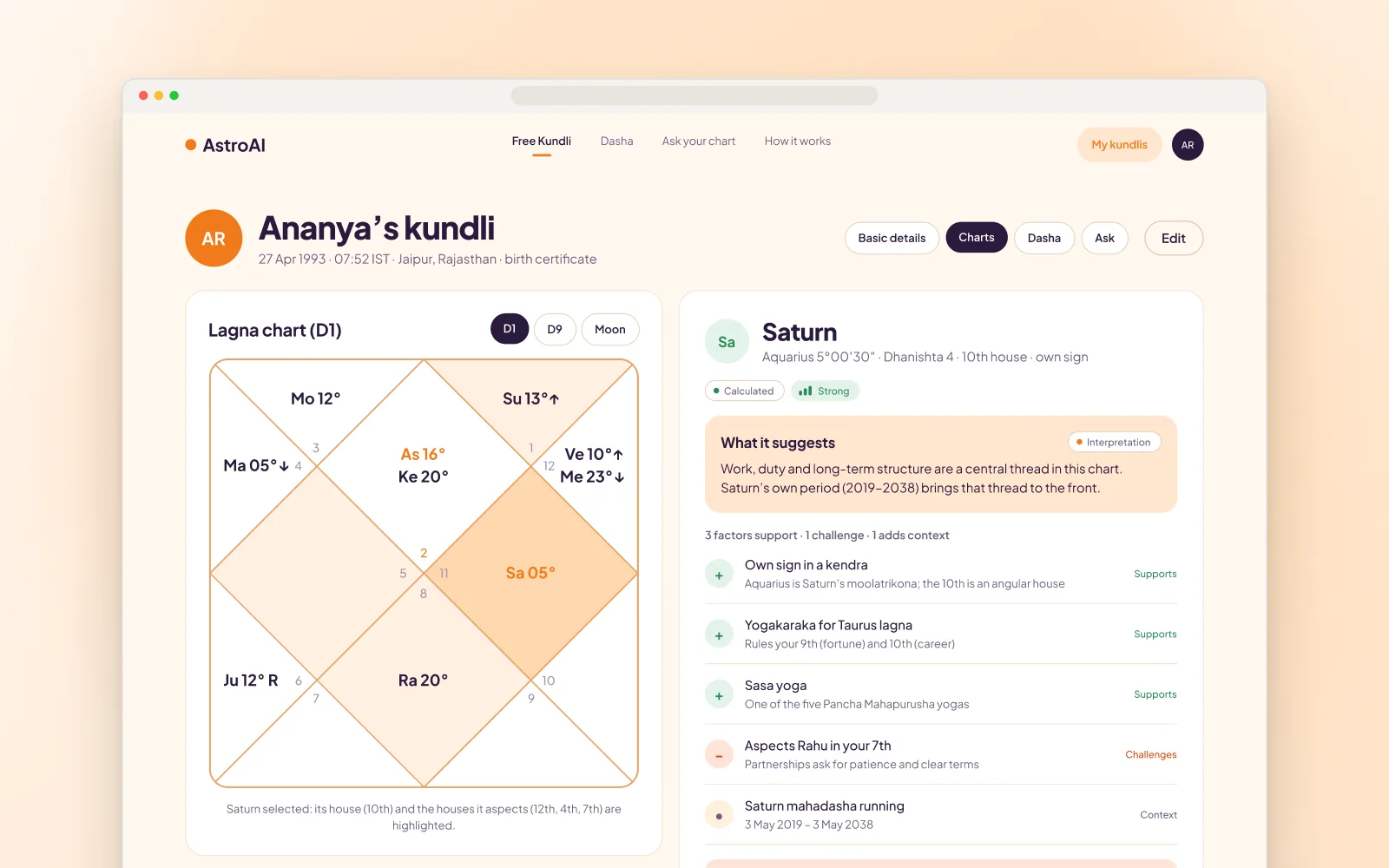
“What supports it, and what doesn’t” lists challenging factors next to supporting ones.

Why it works

Honesty about disagreement should build trust — a hypothesis to test.

Decision 04

Grounded Ask

The problem

AI astrologers produce fluent answers with no link to the chart.

What I did

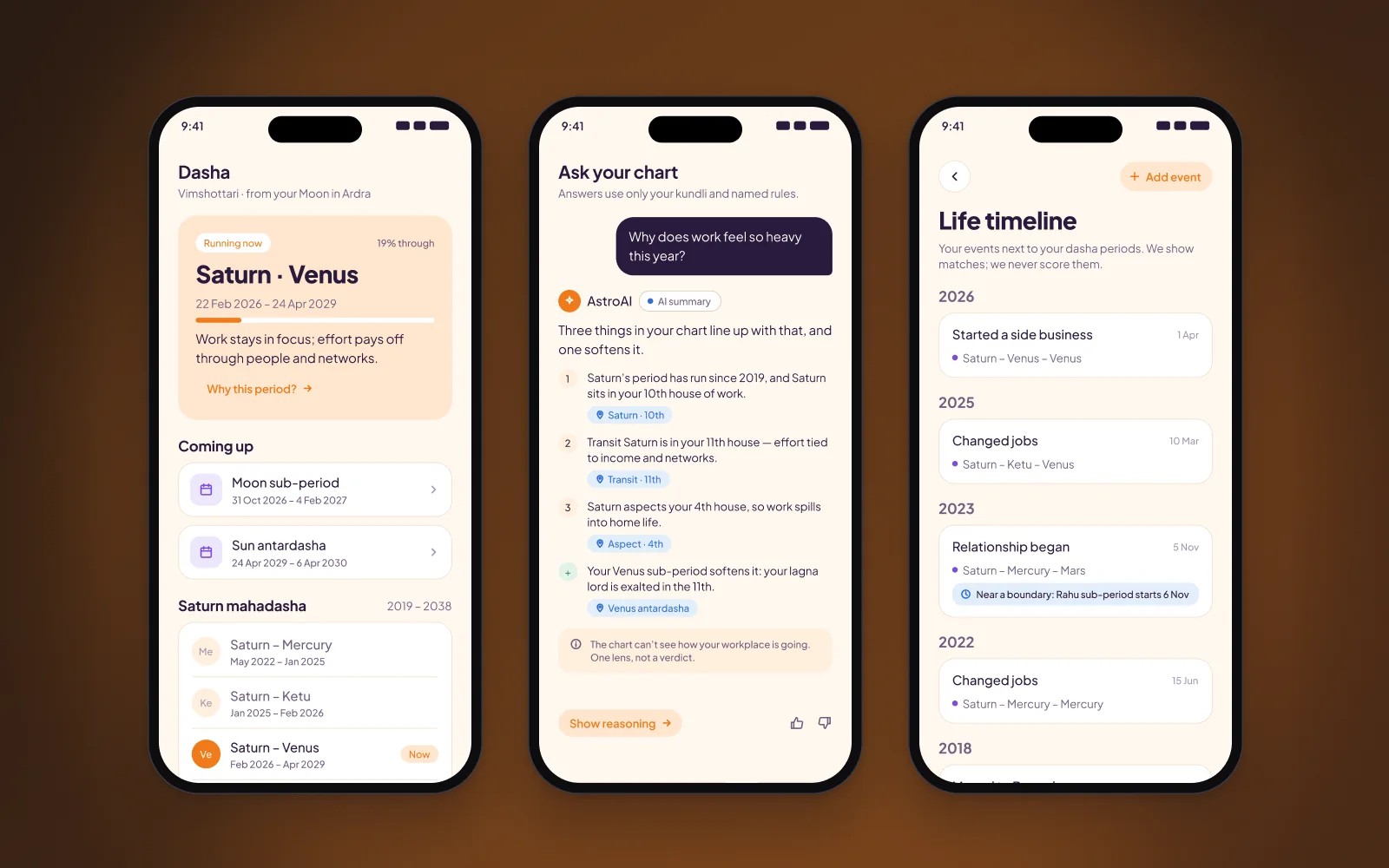
Ask retrieves chart factors first, removes unsupported claims and shows a “grounded in” list.

Why it works

Every claim in an answer traces back to a factor the user can inspect.

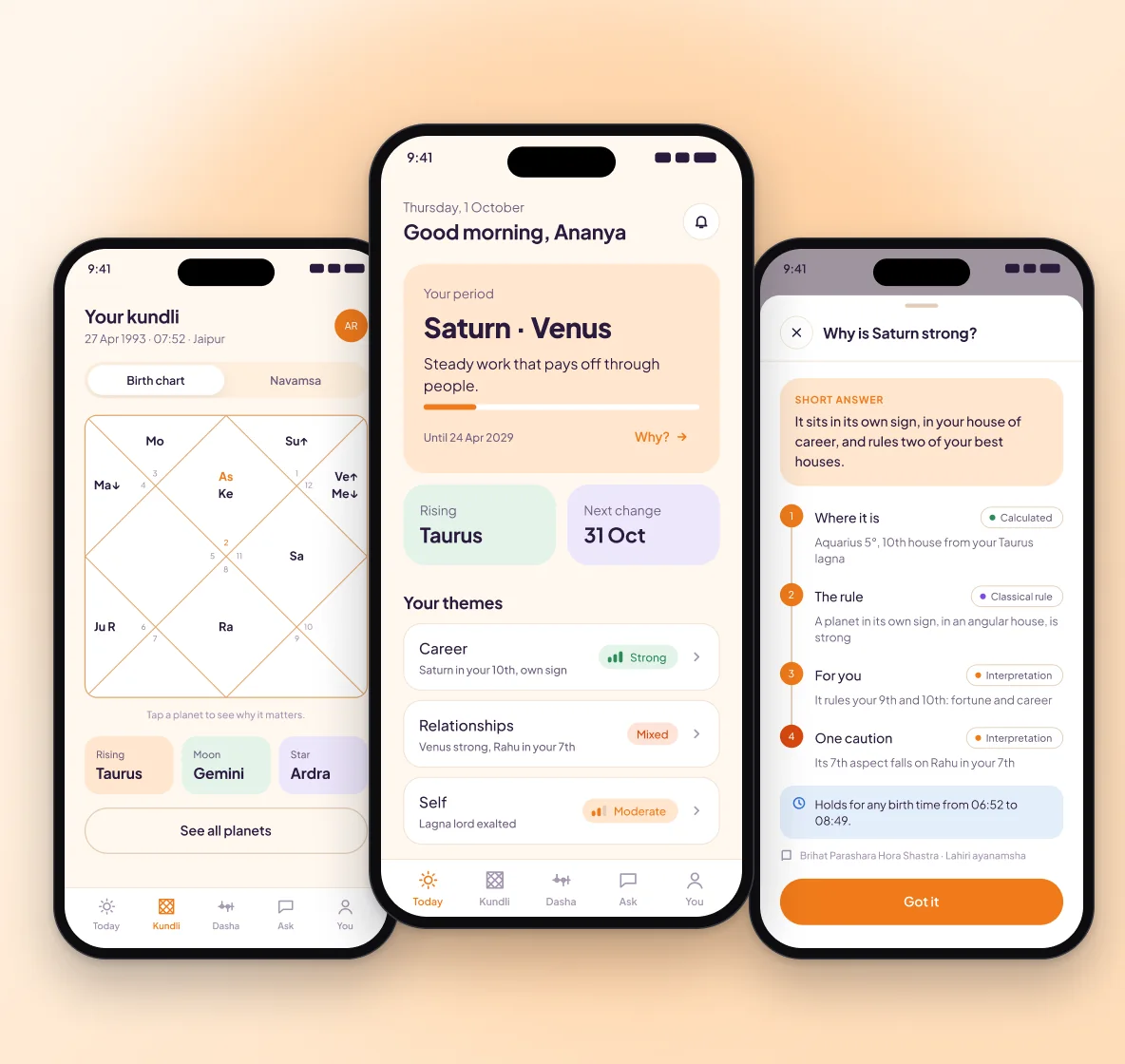
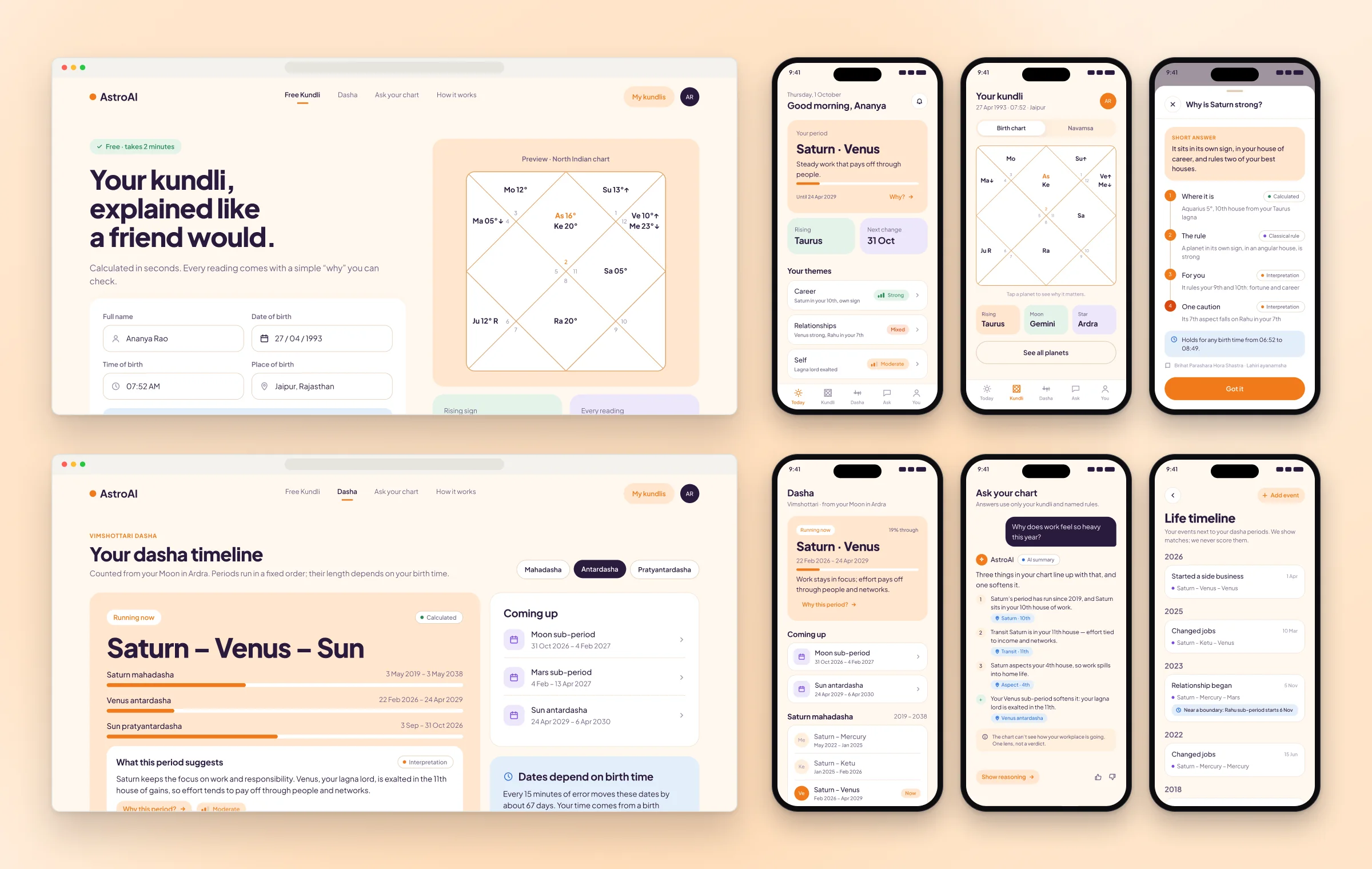
Final designs — Saffron Sunrise · Free Kundli and Dasha on the web; Today, Kundli, Why?, Dasha, Ask and Life timeline in the app

Final designs — Saffron Sunrise · Free Kundli and Dasha on the web; Today, Kundli, Why?, Dasha, Ask and Life timeline in the app

[ Closer look ]
Every reading has a “why”.
01 / 03Every reading has a “why”.Tap a planet to see what is calculated, which classical rule applies and what is interpretation — and the birth-time window it holds for.
The kundli, on the web.
02 / 03The kundli, on the web.The selected planet’s house and aspects light up on the chart, next to the factors that support or challenge the reading.
Dasha, Ask and Life timeline.
03 / 03Dasha, Ask and Life timeline.Periods in plain language, answers that cite the chart, and life events placed next to the periods they fell in.
[ 06 ] Iteration & system

Four rounds, each shaped by direct feedback.

  1. Round 1

    A tool-like product

    This looks like a SaaS dashboard.

    Neutral surfaces, serif interpretations, mono data. Strong on structure — but it read as enterprise software.

  2. Rounds 2–3

    Warmth and familiarity

    A familiar kundli-page layout for web and an Airbnb-style app, then five full directions with identical content to compare.

  3. Final

    Saffron Sunrise

    Warm light surfaces, one saffron accent and rounded tinted tiles — one token-based system for web and app.

[ 07 ] Outcomes & reflection

Ready to test, not yet measured.

Outcomes stay empty until they are measured.

Measures & next steps
  • Task success on the “Why?” flow, with sample size
  • Trust rating with and without the reasoning trace
  • Time to first kundli and 30-day retention
  • Apply the WCAG 2.2 contrast fixes to the Saffron tokens
  • Run 8–12 interviews and the moderated usability test plan
What I learned

Trust is visual before it is logical

The first round had the right reasoning model, but looking like enterprise software undermined trust.

Explainability needs restraint

One idea per screen made the “why” easier to find.

Explore wide, then commit

Five directions with identical content made the choice quick and concrete.