← All work [ Case study 04 · LiTL ]

Making AI‑drafted legal citations verifiable.

LiTL (Lawyer in the Loop) checks every citation in a legal draft against its source and records what the lawyer decided. Built for the Xtrylegal legal-tech hackathon.

Web · MobileHackathonSep 2026
LiTL — key screens
Role
UI/UX designer, end to end
Timeline
Sep 2026
Platform
Web · Mobile
Context
Hackathon · Indian legal practice
[ 01 ] Overview

Separating “a source exists” from “a lawyer checked it”.

AI now drafts first versions of bail applications and petitions. A wrong or misquoted authority is costly in court.

01

The problem

AI drafting tools produce citations that look right. Nothing separated “a source exists” from “a lawyer checked it”.

02

What I did

Defined a six-step verification loop and designed the web app, mobile app and design system around it.

03

Outcome

A review flow where every reference ends in a recorded decision — including honest “unresolved” ones.

How might we

How might we help lawyers verify AI‑drafted citations quickly — while keeping the judgement, and the credit, with the lawyer?
[ 02 ] Insights

Three insights that set the rules.

  1. 01

    Found isn’t checked

    “Located” and “verified” are different states. The interface has to keep them visibly apart.

  2. 02

    Not everything resolves

    Some references can’t be confirmed. Hiding them is worse than showing them honestly.

  3. 03

    Record the document, not the person

    Lawyers reject tools that time, score or compare them. The record describes what happened to the draft.

[ 03 ] Users

Two people on either side of a filing.

Drafts and checks references

Junior associate

Goals — verify every reference quickly; keep evidence of what was flagged

Pain points — citations look right until they aren’t; no record of the checks they did

Reviews and approves filings

Senior partner

Goals — know what was verified before filing; approve or return with context

Pain points — can’t see what was checked; won’t adopt tools that monitor the team

[ 04 ] Principles & structure

Every reference moves through the same loop.

  1. 01Keep “located” and “verified” visibly apart.
  2. 02Show unresolved references honestly, with a reason.
  3. 03Record the document, not the person.
  4. 04The lawyer keeps the judgement — and the credit.
  5. 05Only claim what the product can actually know.
User flow
UploadDetectLocatePresentReviewDecideRecordSenior approval
Information architecture
WorkspaceDocumentsReview queueReportsTeamConfirm · Correct · Reject · Leave unresolved
[ 05 ] Key decisions

The decisions that mattered most.

Decision 01

Located and decided are separate columns

The problem

A “found” source was treated as a verified one.

What I did

A reference can be located with no decision recorded yet, and the Located filter always matches the Located count.

Why it works

Numbers never contradict each other, and nothing looks checked before it is.

Decision 02

Claim and source, side by side

The problem

Comparing meant jumping between the draft and the judgment.

What I did

The claim is marked in gold, the located passage in blue; the claim only turns green after the lawyer confirms.

Why it works

Colour never implies a check that didn’t happen.

Decision 03

Unresolved is a state, not an error

The problem

Some references can’t be confirmed.

What I did

Leaving one open asks for a written reason that travels with it — amber and static, never blinking or red.

Why it works

Honest uncertainty reaches the partner instead of disappearing.

Decision 04

Senior review closes the loop

The problem

Partners couldn’t see what was checked before a filing went out.

What I did

The partner sees what was confirmed, corrected and left open, then approves or returns it; the record keeps both versions.

Why it works

Approval rests on evidence, not trust.

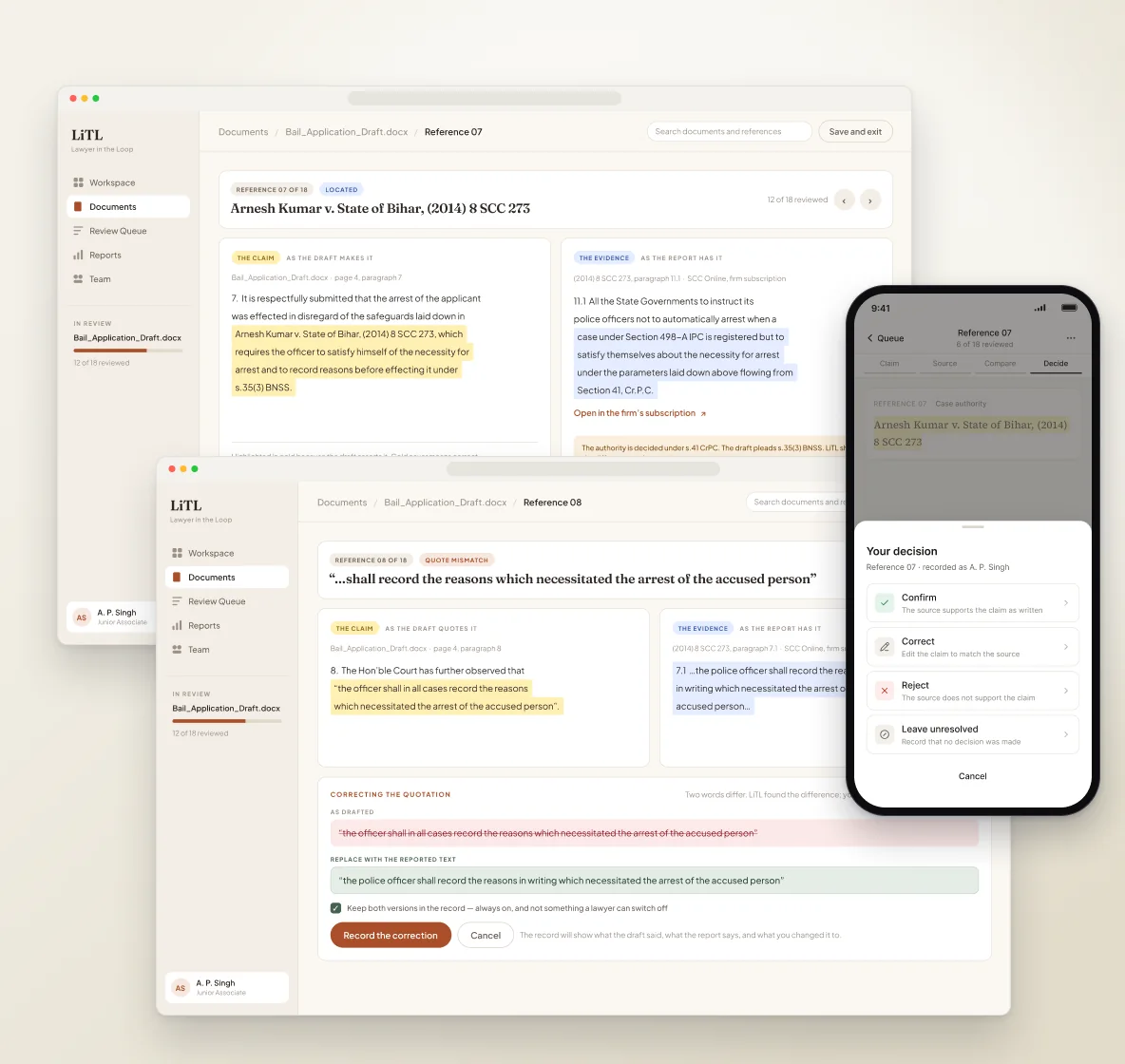
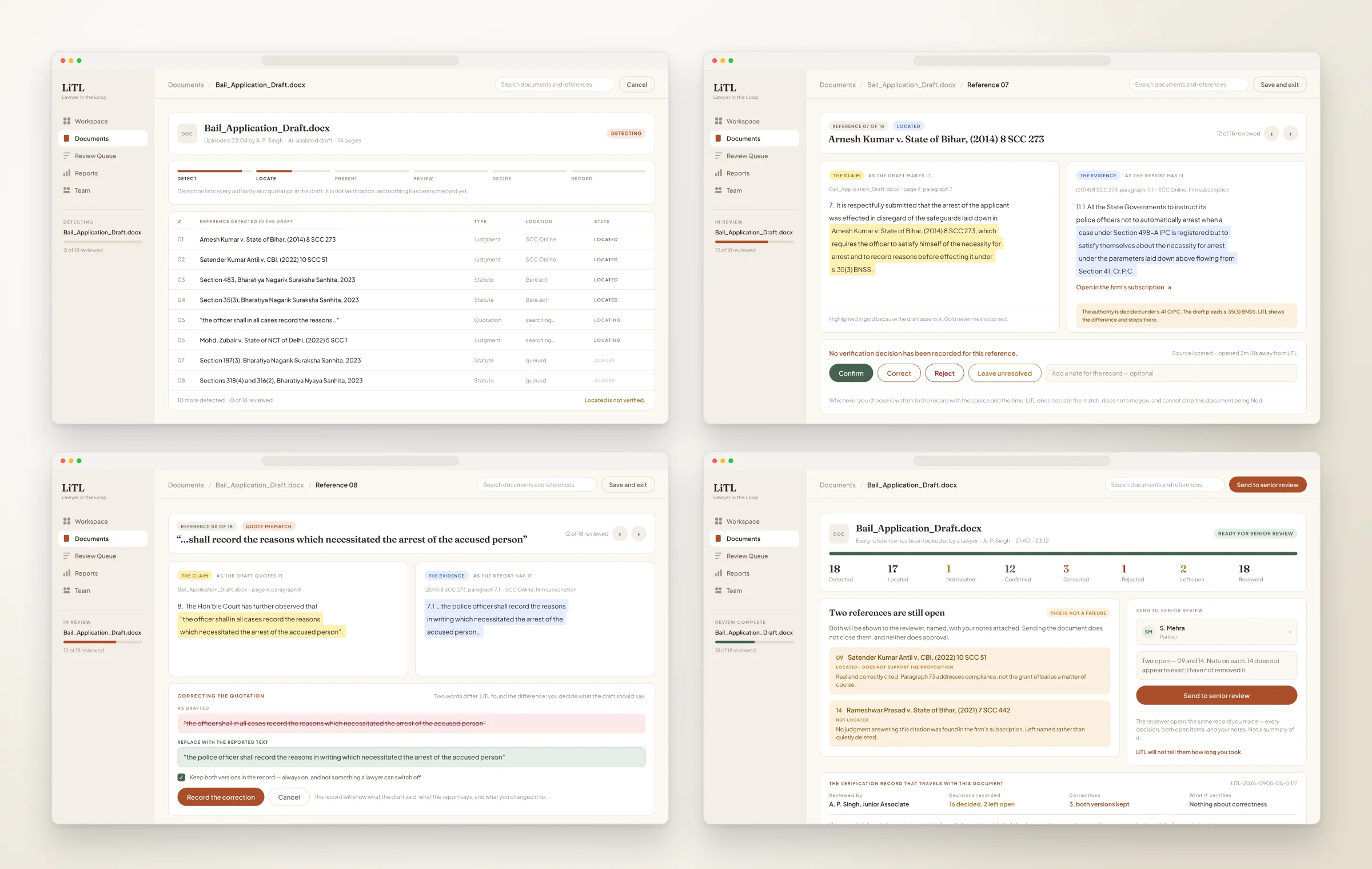
Final designs — upload and detection, reference review, correcting a quotation, and sending for senior review

Final designs — upload and detection, reference review, correcting a quotation, and sending for senior review

[ Closer look ]
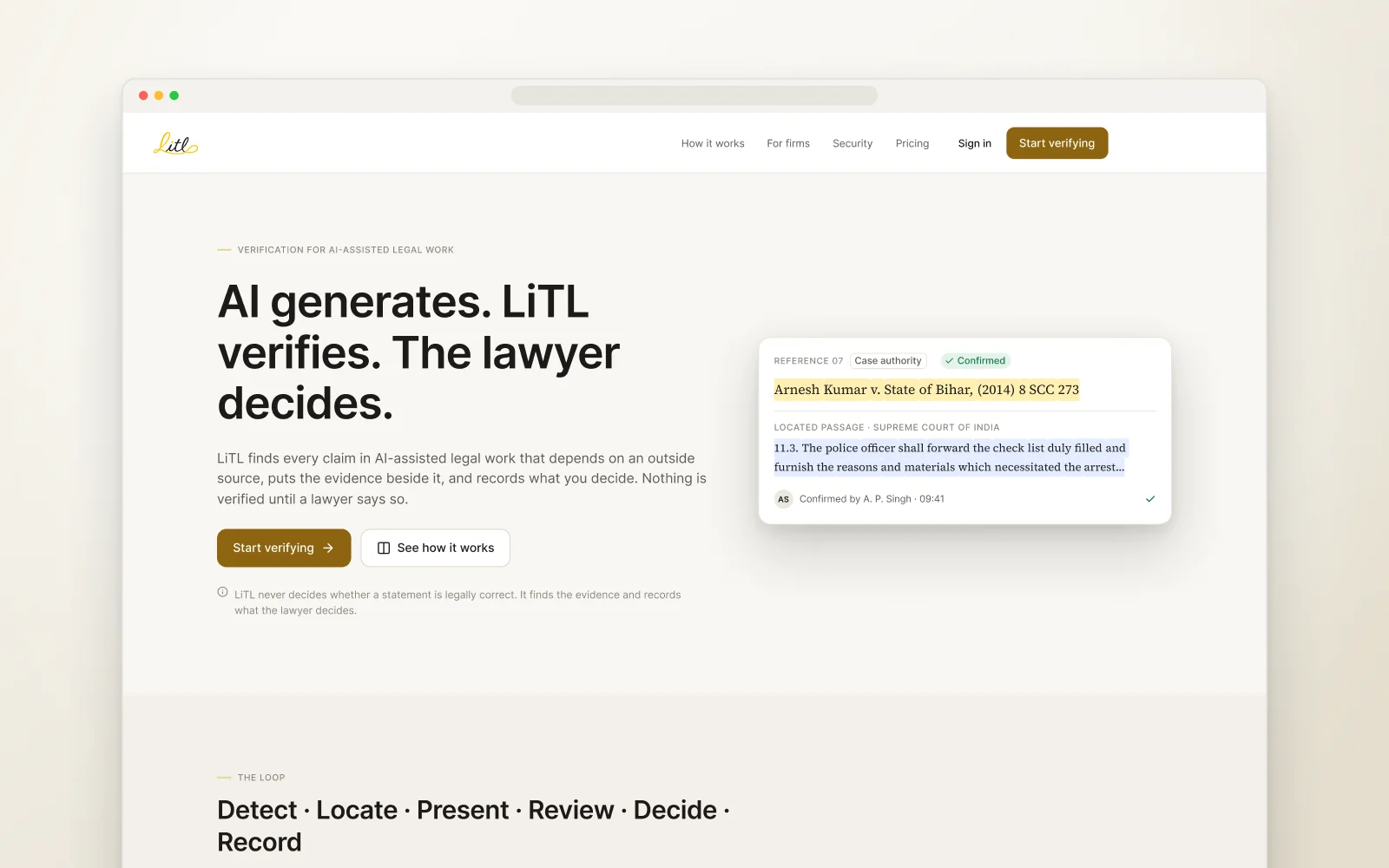
AI generates. LiTL verifies. The lawyer decides.
01 / 03AI generates. LiTL verifies. The lawyer decides.The landing page leads with the promise and shows a real verified reference instead of an abstract illustration.
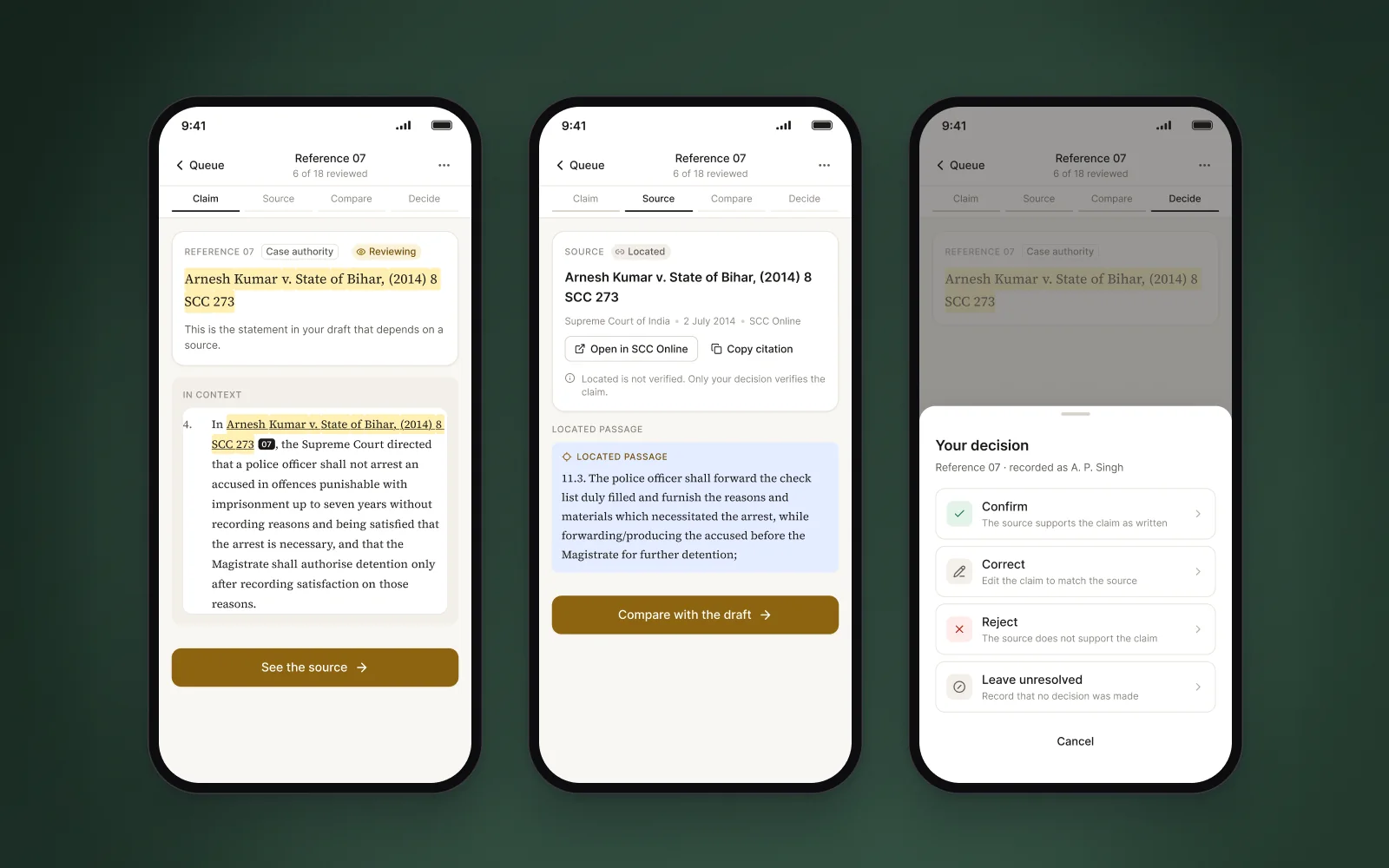
Claim, source, decide — on a phone.
02 / 03Claim, source, decide — on a phone.Each reference is reviewed in three steps, and the decision always stays with the lawyer: confirm, correct, reject or leave unresolved.
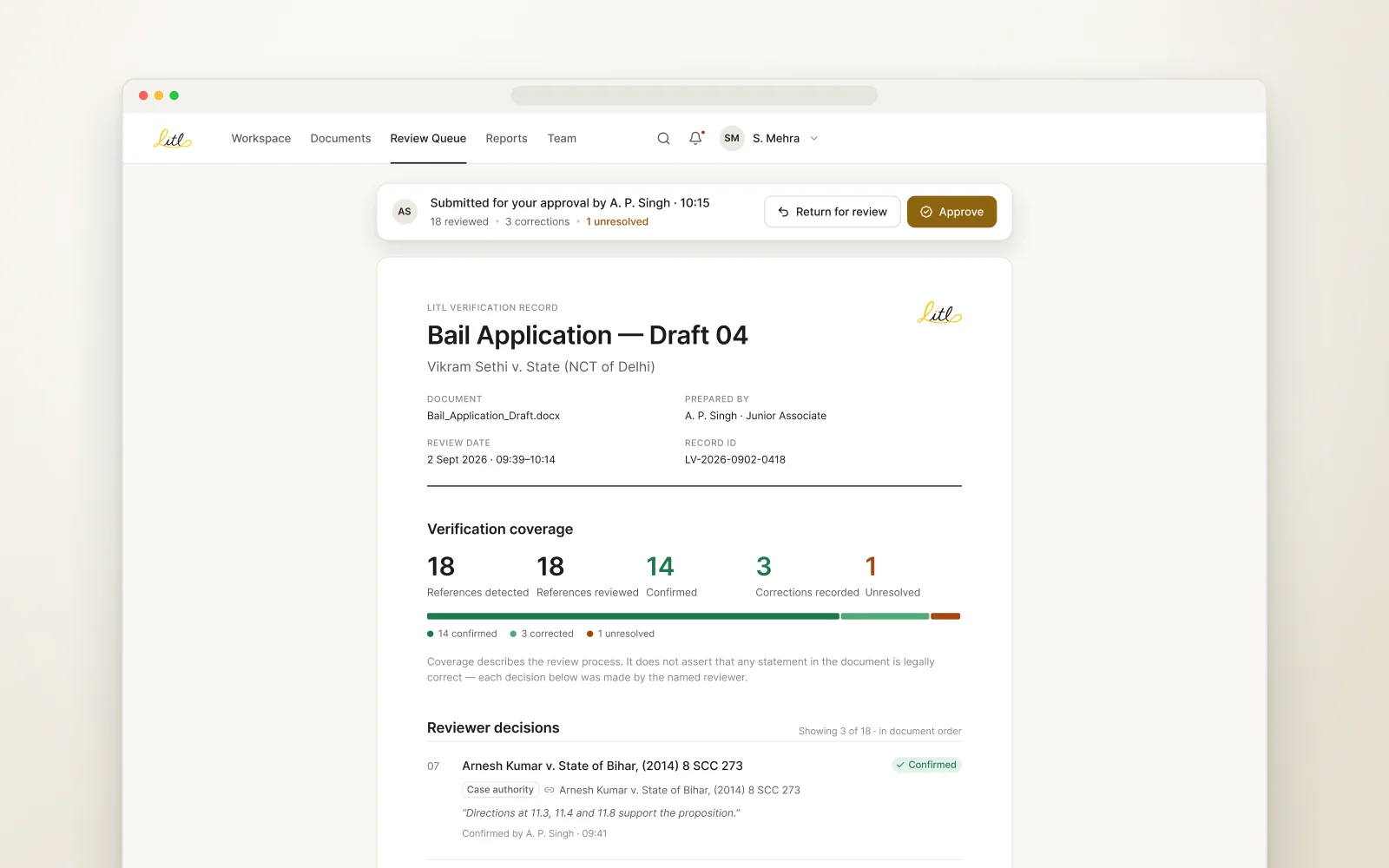
A record that travels with the document.
03 / 03A record that travels with the document.The senior’s approval view: coverage, corrections and open items, with every decision attributed to a named reviewer.
[ 06 ] Iteration & system

Small labels, big consequences.

  1. Honest labels

    Say only what the product knows

    The product says “source opened · 2m 41s away from LiTL” — never “read for 2m 41s” — because it can only know the first.

  2. Colour as meaning

    Two highlight families that never mix

    Gold for the draft’s claim, blue for the located passage, green only after a decision — so colour always tells the truth about state.

[ 07 ] Outcomes & reflection

The whole loop, end to end.

Outcome
  • 18 of 18 references reviewed in the demo document
  • Submitted to the Xtrylegal hackathon as “Lawyer in the Loop”
  • Next: source-excursion tracking
  • Next: deep links into the firm’s own SCC Online / Manupatra subscription
  • Next: a verification record clients and courts can see
What I learned

Honest labels are a design decision

The product can know a source was opened — not that it was read — and the copy has to say exactly that.